
Blog
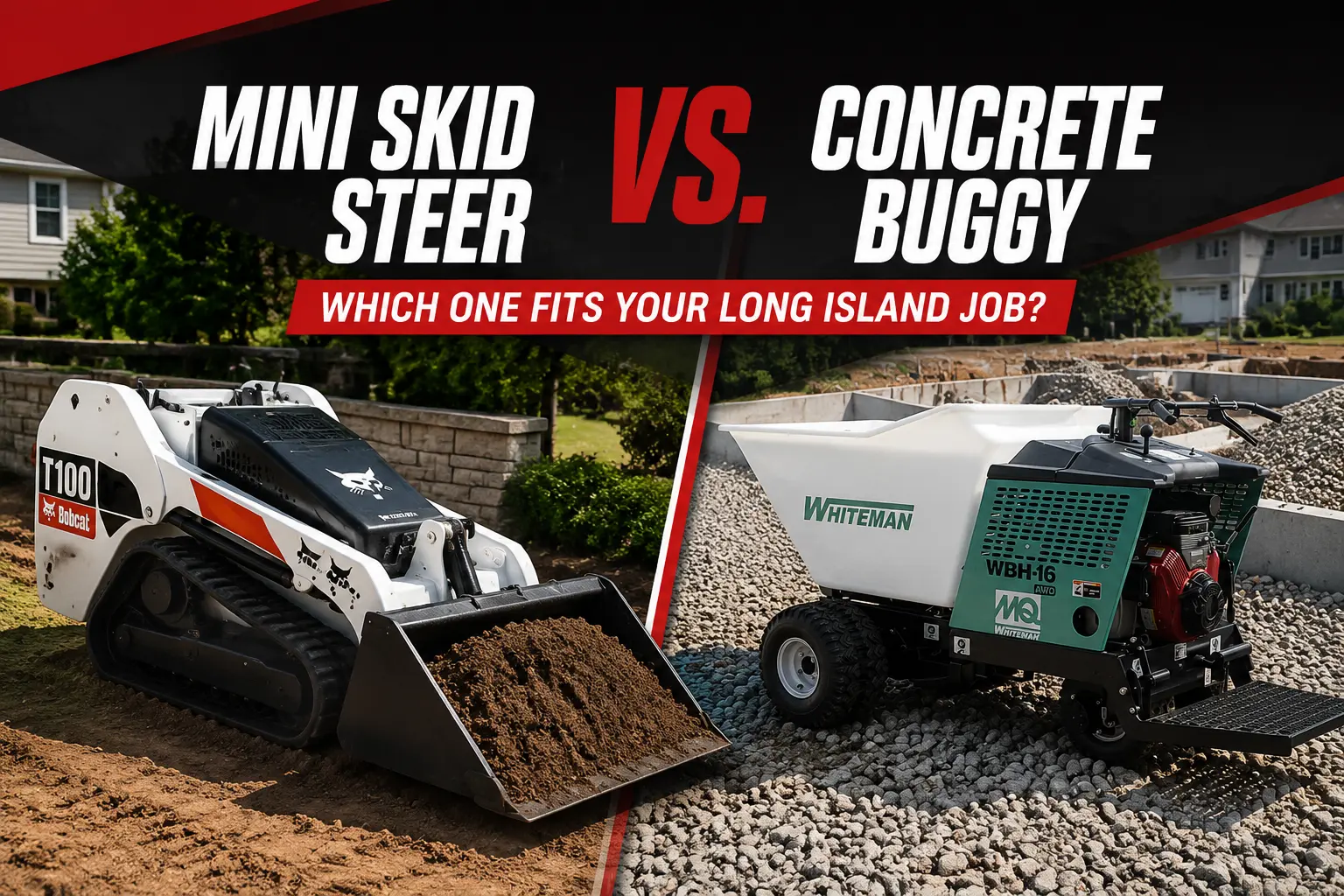
What a Mini Skid Steer Actually Does
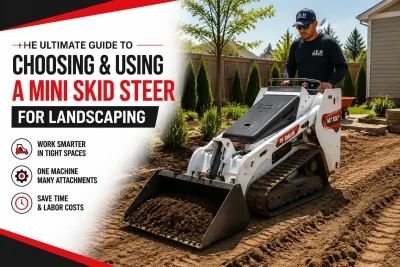
A mini skid steer sometimes called a mini track loader is a scaled-down skid steer built to fit where full-size equipment can’t go. That matters a lot on Long Island, where older homes in towns like Garden City, Farmingdale and Huntington were built with narrower side yards and gates than newer developments elsewhere. A compact machine like the Bobcat MT100 is about 35.6 inches wide with its standard narrow tracks (41.1 inches with the wide-track option), which means it can walk through a standard gate or down a tight side yard without anyone swinging a sledgehammer to widen the path first.
What makes it more than a fancy wheelbarrow is the attachment system. The same machine that carries a bucket of soil in the morning can run a trencher, auger, grader blade or pallet forks by afternoon. Based on manufacturer specifications, the MT100 has a rated operating capacity around 1,000 lbs, an operating weight near 3,390 lbs and roughly 25 horsepower (24.8 hp) enough to grade a yard, dig a trench for drainage pipe or move pallets of pavers. (Always confirm current specs with our team or the manufacturer before finalizing your rental Bobcat updates model specs periodically.)
Best suited for:
- Regrading or leveling a yard before sod or paver installation
- Digging trenches for irrigation, drainage or utility lines
- Moving mulch, soil, gravel or pavers in bulk
- Backfilling around foundations or retaining walls
- Any job that needs more than one type of task done, not just one repeated task
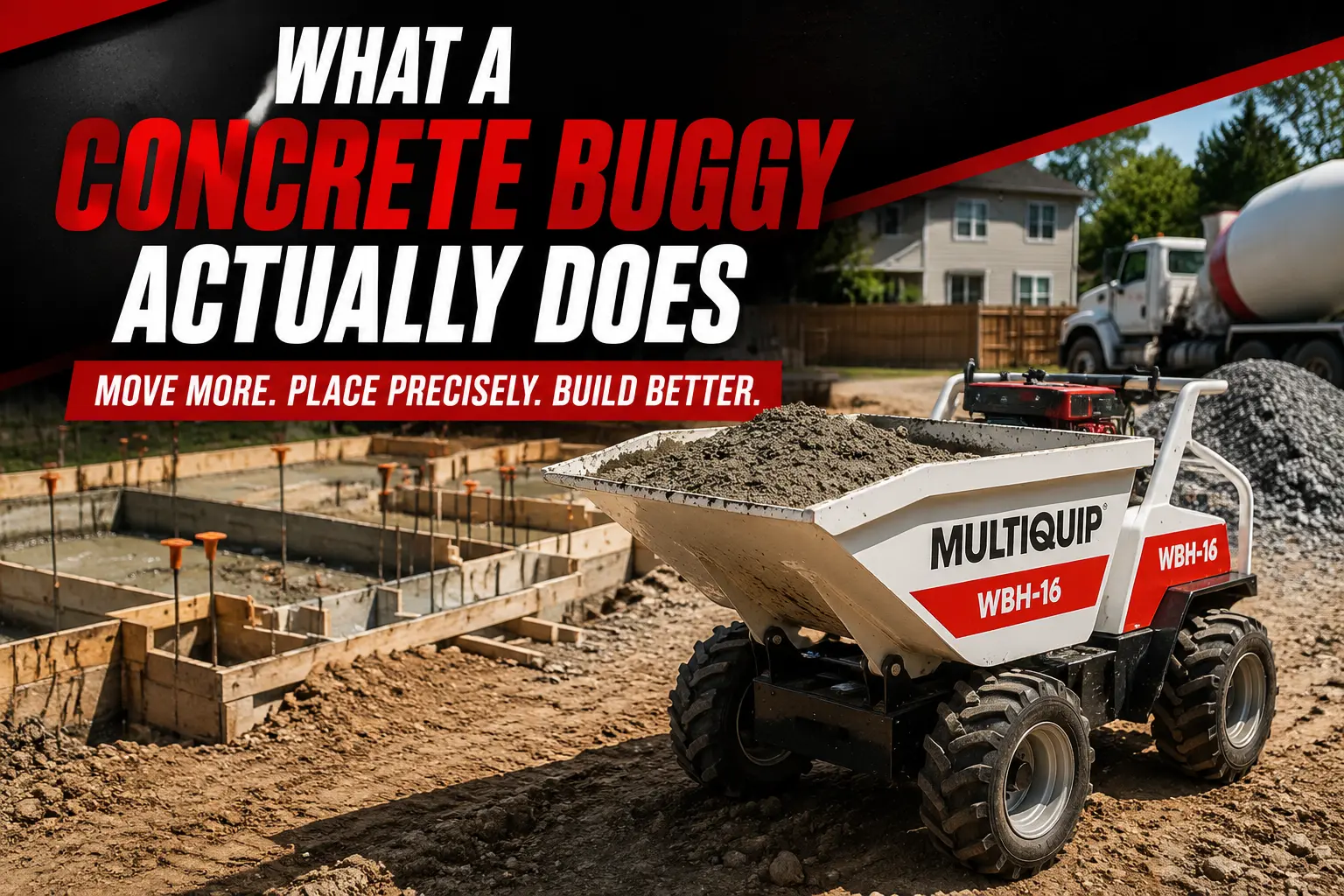
What a Concrete Buggy Actually Does
A concrete buggy also called a power buggy or mud buggy has one core job and does it well: moving wet concrete, mortar or heavy loose material from the truck or mixer to the exact spot it needs to be placed. This is especially useful on Long Island and NYC job sites where a ready-mix truck often can’t get anywhere near the actual pour location think a backyard patio behind a house in Babylon, a foundation pour on a narrow Brooklyn lot or a walkway on a sloped Suffolk County property.
Concrete Buggy Capacity: How to Size the Right Machine
Concrete buggies aren’t one-size-fits-all and picking the wrong capacity is one of the more common rental mistakes on smaller jobs. Here’s a general sizing guide based on standard buggy classes:
| Buggy Type | Typical Capacity | Best For |
| Compact walk-behind (e.g., 6 cu. ft. poly/steel tub, ~34–36 in. wide) | 6 cu. ft. | Tight interior access, small patio sections, demolition debris, jobs behind a 36-inch gate or doorway |
| Standard wheeled buggy (e.g., Multiquip WBH-16) | 16 cu. ft. | The industry-standard size for most residential driveways, patios and sidewalk pours on firm, level ground |
| Track-driven buggy (e.g., WTB-16) | 16 cu. ft. | Same capacity as a standard wheeled buggy but built to cross soft, muddy or freshly graded soil without sinking |
| Larger wheeled buggy (e.g., WBH-21EF) | 21 cu. ft. | Bigger continuous pours larger patios, foundations or slabs where fewer trips means real time savings for a crew |
As a rule of thumb: match the buggy’s tub capacity to how much material you can place before it starts to set and match the drive type (wheeled vs. tracked) to your ground conditions rather than to the pour size. A 16 cu. ft. wheeled buggy on soft, rain-soaked soil will spin its wheels and cost you more time than a smaller tracked unit would.
Best suited for:
- Pouring concrete for driveways, patios, sidewalks and foundations
- Moving mortar or masonry material to a hardscaping crew
- Jobs where the ready mix truck or mixer can’t reach the pour site directly
- Sloped or soft-ground sites where a wheelbarrow crew would struggle to keep pace with a pour
A concrete buggy is often the more efficient choice for these jobs but it isn’t the only option very small pours may still be handled fine with wheelbarrows and very large, continuous pours are sometimes better served by a concrete pump truck. The buggy earns its keep in the middle ground: pours too big for a wheelbarrow crew but not large enough to justify a pump.
A note on safety: concrete buggies are designed for graded, ramped or reasonably level travel paths. They are not a substitute for stairs or steep, unramped grades moving a loaded buggy over stairs or a sharp drop is a tip-over and injury risk. If your site has stairs or a steep unramped slope between the truck and the pour, plan for a ramp, a different route or a pump line instead.
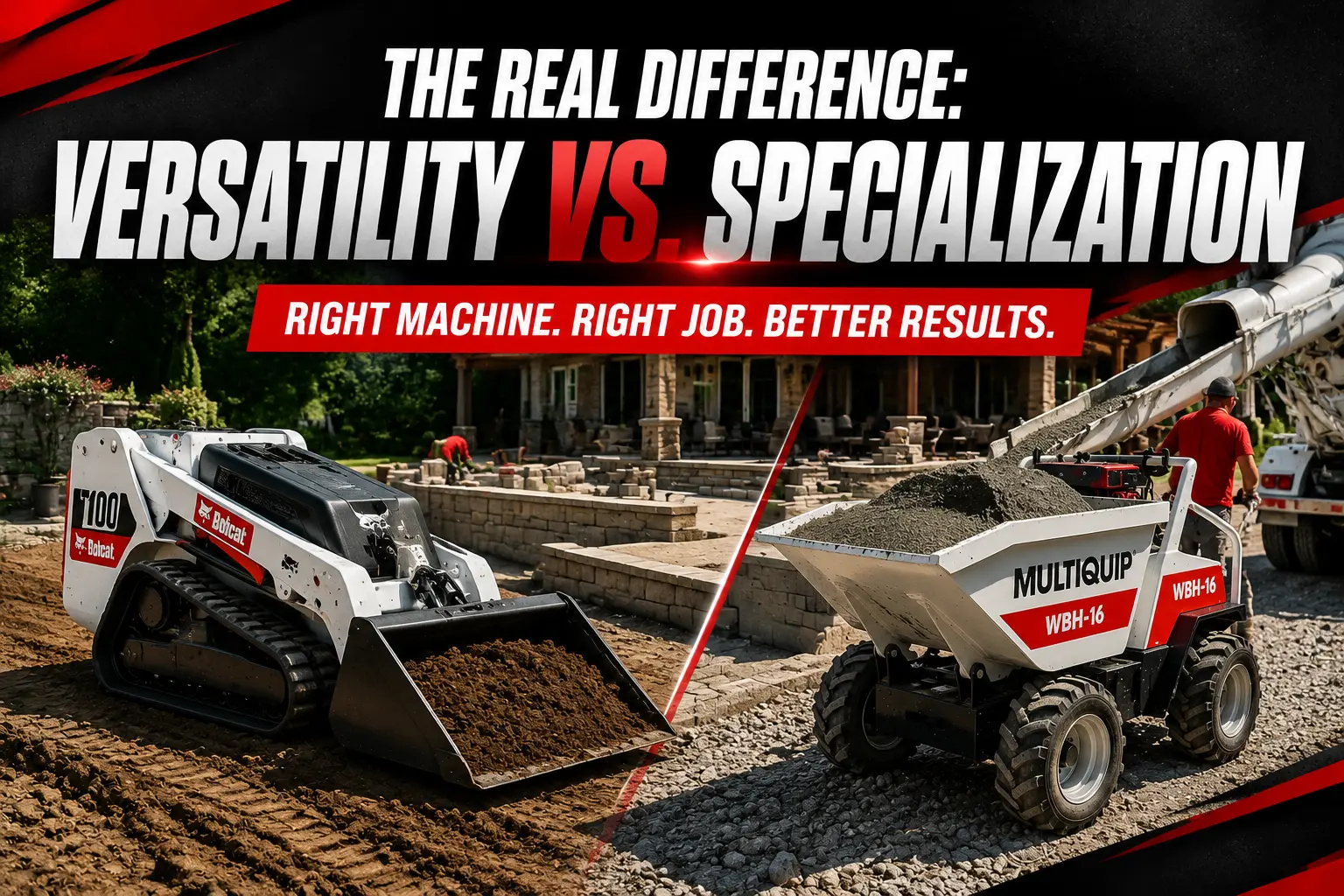
The Real Difference: Versatility vs. Specialization
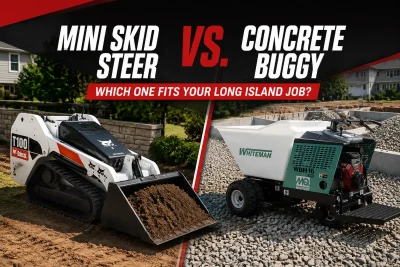
Here’s the simplest way to think about it. A mini skid steer is a generalist it earns its rental fee across a dozen different tasks over the life of a project. A concrete buggy is a specialist it’s built around one task, moving heavy wet material short distances over graded ground and it does that one task well.
If your project is a full landscape renovation regrading, trenching, planting beds, hauling materials the mini skid steer will typically save you more labor hours because it doesn’t sit idle between tasks. If your project centers on a concrete pour a new patio, a driveway extension, a foundation a buggy will usually save your crew more time and back strain than a loader would, since a skid steer bucket isn’t built for controlled, repeated dumping of wet concrete.
When You Actually Need Both
On bigger jobs a full backyard hardscape installation with a new patio, retaining wall and paver walkway, common across Nassau and Suffolk Counties it’s common to rent both. The mini skid steer handles excavation, grading and material staging early in the project. The concrete buggy takes over once it’s time to pour footings, set the patio base or move mortar to the masons. Renting them back to back, rather than simultaneously, is usually the more cost-effective approach unless you have two crews working at once.
Questions to Ask Before You Book
- What’s the access like? Gates or doorways under 36 inches wide rule out most standard equipment and point you toward compact models of either machine common on older Long Island properties in towns like Garden City and Hempstead.
- Is the material wet or dry? Wet concrete and mortar are usually a buggy’s job. Soil, mulch, gravel and pavers are typically a skid steer’s territory.
- How firm is the ground? Soft, muddy or freshly disturbed soil favors tracked equipment over wheeled equipment, for both skid steers and buggies.
- How much material are you placing and how fast will it set? This determines whether a 6 cu. ft., 16 cu. ft. or 21 cu. ft. buggy tub is the right call.
- Is this a one-task job or a multi-task job? One task, done repeatedly, points to a buggy. Several different tasks over the course of the project points to a mini skid steer.
- How will the machine travel between the truck and the work area? Flat, graded paths work for either machine; stairs or steep unramped grades need a different plan entirely.