
Blog
When you’re planning a concrete pour whether it’s a foundation, patio, driveway or commercial slab you need to move material quickly and efficiently. But which equipment gets the job done right: a concrete buggy, a concrete pump or even a wheelbarrow? The answer depends on your jobsite conditions, timeline and budget. In this guide, we’ll break down the real costs, speed comparisons and practical use cases so you can make the right choice for your Long Island or NYC concrete project.
What Is a Concrete Buggy?
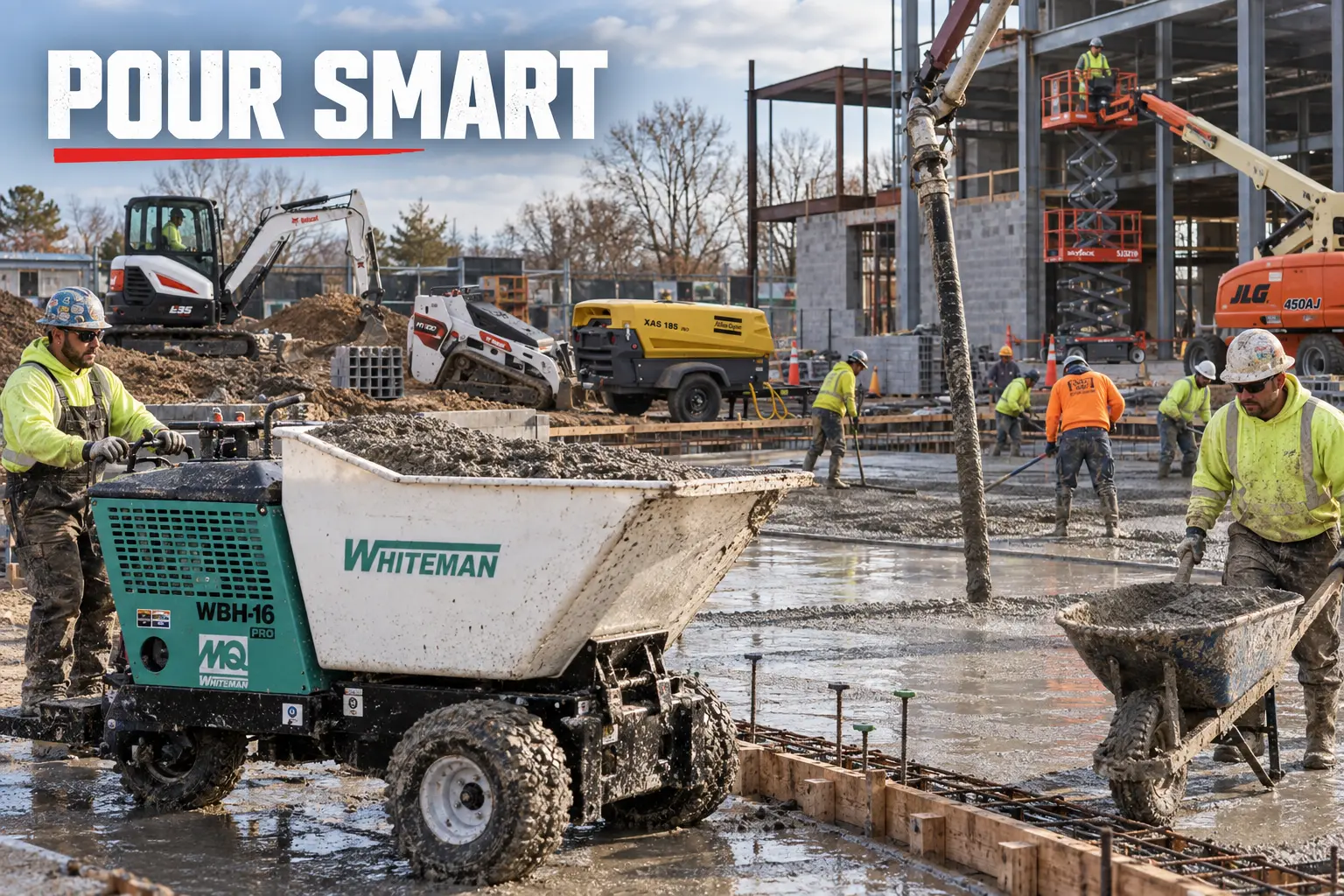
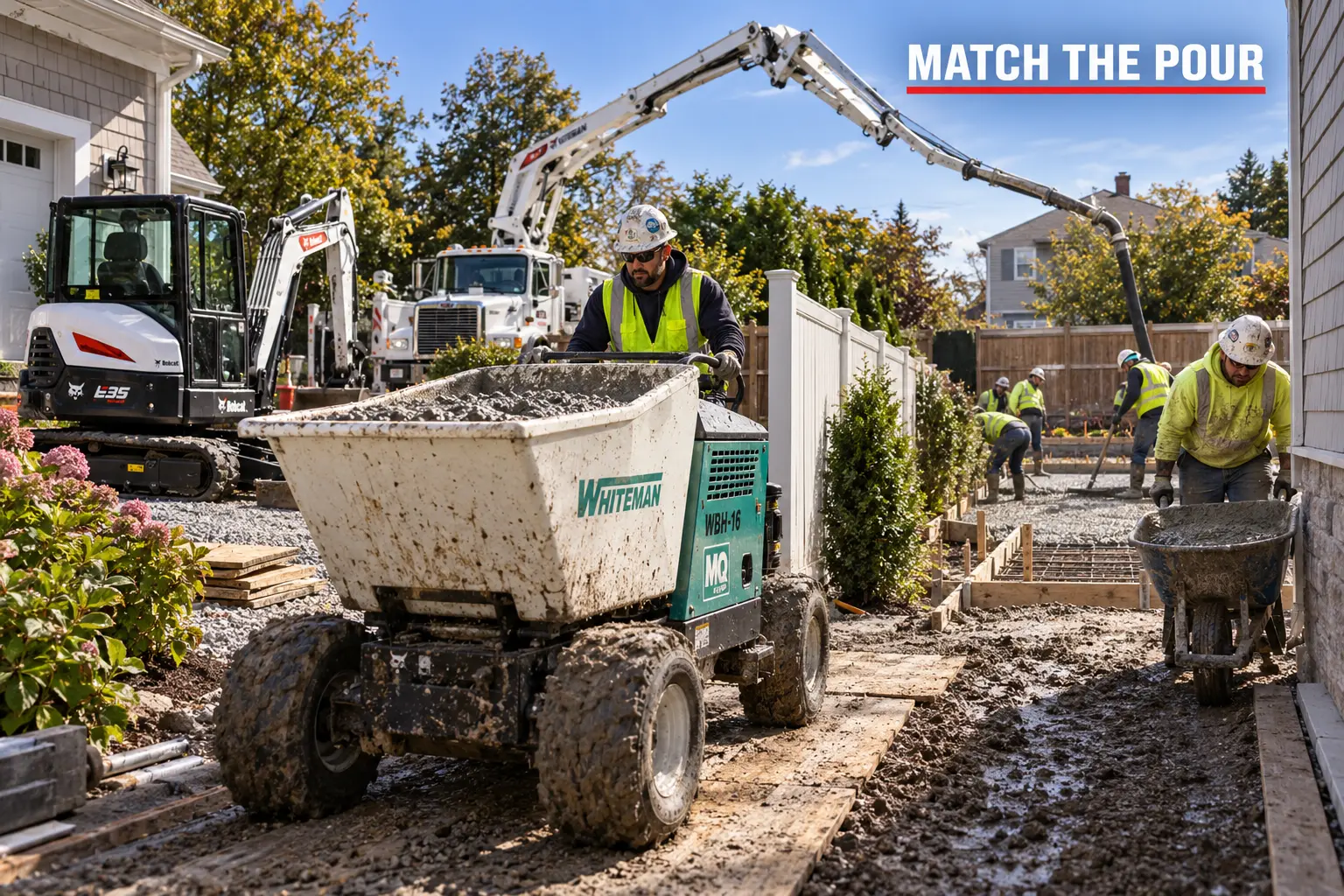
A concrete buggy (also called a power buggy or concrete cart) is a motorized, tracked or wheeled vehicle designed to transport concrete from a ready-mix truck to the actual pour location. The typical Multiquip WBH concrete buggy holds between 10 to 19 cubic feet of concrete and can navigate tight spaces, slopes and uneven terrain that a wheelbarrow simply can’t handle.
The buggy operates with either a gas engine or battery power and uses either tracks or wheels for traction. Tracked models excel on muddy jobsites and soft ground, while wheeled versions perform better on compacted surfaces and cleaner areas.
Concrete buggies are perfect for contractors managing mid-size pours where the distance from the truck to the pour exceeds what a human can reasonably carry by wheelbarrow. They’re faster than manual methods and smaller than full-sized concrete pumps making them ideal for tight-access jobs and suburban residential work.
What Is a Concrete Pump?
A concrete pump forces liquid concrete through a boom arm and hose directly to the pour point. Concrete pumps come in two main types: truck-mounted boom pumps (which can reach 100+ feet) and line pumps (smaller, placed on a flatbed).
Boom pumps are standard for large commercial projects, high-rise buildings and pours where the concrete truck can’t get close to the work. They deliver massive volumes of concrete quickly often 40 to 80 cubic yards per hour and eliminate the need for manual transport.
Line pumps are more portable and cost-effective than boom pumps but still require professional operators and substantial jobsite setup. Both types ensure consistent concrete flow and reduce segregation (when aggregate separates from the cement paste), which improves the finished product’s quality.
What About the Wheelbarrow?
The wheelbarrow is the entry-level concrete transport method. It holds about 3 to 5 cubic feet and relies entirely on manual labor. A single worker can push a loaded wheelbarrow roughly 50 to 100 feet before fatigue becomes a serious issue.
Wheelbarrows work fine for small residential projects a small patio pour, a few foundation sections or minor repair work. But they scale poorly. A 100-cubic-yard pour with wheelbarrows alone would require dozens of trips and exhaust your crew. Plus, the repetitive motion and heavy loads increase injury risk on your team.
Concrete Buggy vs Concrete Pump: Cost Comparison
Cost is often the deciding factor. Here’s what you’re typically looking at:
Concrete Buggy Rental Cost
A concrete buggy rental runs between $150 to $300 per day, depending on the model and location. Weekly rates drop to $400–$600. Daily rates are reasonable for single-day pours and you can often get same-day or next-day delivery and pickup on Long Island and Nassau County.
Total project cost for a concrete buggy? Typically $200–$400 when you factor in fuel (usually included), operator time and cleanup. No expensive setup fees, no specialized operator required and the equipment fits through standard gates and tight access points.
Concrete Pump Rental Cost
A truck-mounted boom pump costs $500–$1,500 per day, plus an operator (another $75–$150 per hour), plus setup and standby fees. A line pump runs $300–$700 per day. For larger commercial pours with high volumes, the per-cubic-yard cost becomes competitive. But for residential or small commercial work, the total bill climbs fast.
A typical small boom pump job easily runs $1,500–$3,000 once you add the operator, travel time and minimum job fees.
Wheelbarrow Cost
A wheelbarrow costs $30–$50 per day to rent or $100–$200 to buy. But labor is the real expense. A crew of 3–4 workers spending 6–8 hours moving concrete will cost far more than the wheelbarrow itself. For anything beyond a tiny residential project, the labor math doesn’t work in wheelbarrow’s favor.
Speed: Which Equipment Moves Concrete Fastest?
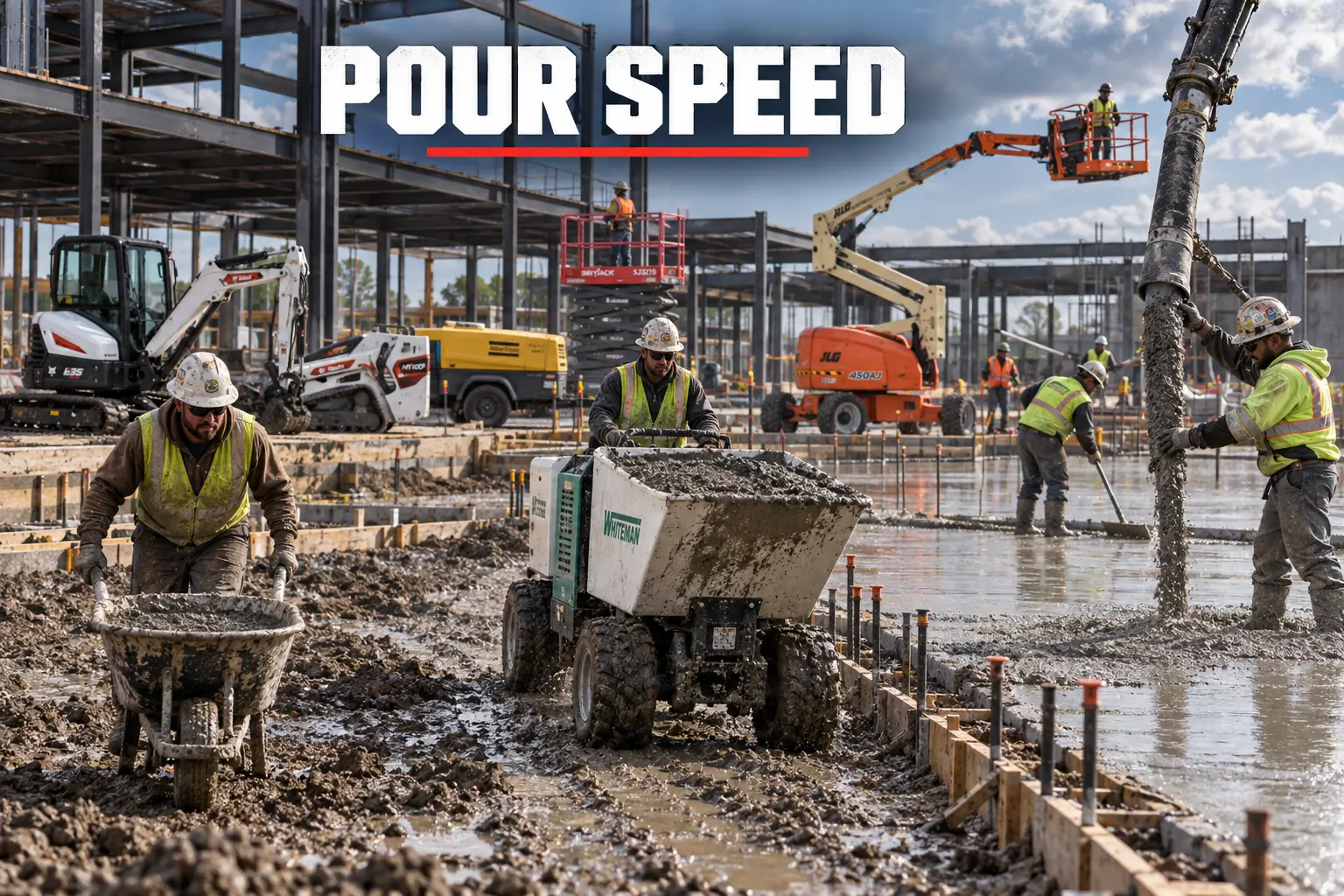
Time is money on construction sites. Here’s how the three stack up:
Concrete Pump: Fastest. Delivers 40–80+ cubic yards per hour directly to the pour location. For large jobs, nothing beats a boom pump. The concrete flows continuously, minimizing delays and allowing your crew to focus on finishing and screeding.
Concrete Buggy: Second fastest. A single buggy handles 8–12 cubic yards per hour (depending on distance and terrain), which is plenty for residential work and smaller commercial projects. Multiple buggies can work in parallel, pushing capacity higher.
Wheelbarrow: Slowest. Realistic capacity is 2–4 cubic yards per hour with a crew of 3–4 people. Anything beyond 15–20 cubic yards becomes impractical with wheelbarrows alone.
Best Uses for Each Method
When to Rent a Concrete Buggy
- Residential driveways, patios and walkways (8–25 cubic yards)
- Tight-access jobsites where a concrete truck can’t position itself
- Backyards, narrow alleyways and confined urban lots
- Foundation work on steep slopes or uneven terrain
- Small commercial projects or renovations
- When your ready-mix truck can’t get within pumping distance
Concrete buggies excel in the 10–40 cubic yard range. They’re cost-effective, operator-friendly and get the job done without the premium pricing of a pump.
When to Rent a Concrete Pump
- Large commercial slabs (50+ cubic yards)
- High-rise buildings or upper-floor concrete placement
- Projects requiring rapid concrete placement (time-critical pours)
- Situations where concrete must be pumped up multiple stories
- Professional projects where finishing speed is critical
Pumps make economic sense when your pour exceeds 40–50 cubic yards, when vertical distance matters or when your timeline is extremely tight.
When to Use a Wheelbarrow
- Very small pours (under 5 cubic yards)
- Repair work or small patch jobs
- Projects with zero equipment access
- When labor is cheap and time is not a constraint
Realistically, modern contractors use wheelbarrows as a supplement, not the primary method. Pair one with a concrete buggy for the final finishing touches, but don’t rely on wheelbarrows alone for any substantial pour.
How to Choose the Right Equipment for Your Project
Ask yourself these questions before deciding:
1. How Much Concrete Are You Pouring?
Under 15 cubic yards? A concrete buggy is usually the sweet spot. 15–40 cubic yards? Still buggy territory, though a pump becomes viable if your crew is small. Over 50 cubic yards? Strongly consider a pump the labor savings justify the cost.
2. What’s Your Site Access Like?
Can a concrete truck get within 20–30 feet of the pour? If yes, a pump or buggy works. If the concrete truck must park on the street and your actual pour is 80 feet away through a backyard gate, a concrete buggy is your answer. Pumps need solid positioning for the boom arm.
3. How Much Time Do You Have?
Same-day pour with a tight crew? A pump reduces the time constraint and removes dependency on manual hauling. Multi-day pour or smaller residential job? A buggy gives you flexibility and better daily cost control.
4. What’s Your Budget?
If costs are tight, a concrete buggy is the middle ground. You’re not paying pump operator rates, but you’re not stuck with wheelbarrow labor either. For Nassau County, Suffolk County and Long Island residential concrete work, the buggy delivers ROI.
Concrete Buggy vs Concrete Pump: Direct Comparison Table
| Factor | Concrete Buggy | Concrete Pump | Wheelbarrow |
|---|---|---|---|
| Daily Rental Cost | $150–$300 | $500–$1,500+ | $30–$50 |
| Capacity (per load) | 10–19 cu ft | 40–80+ cu yd/hr | 3–5 cu ft |
| Operator Required | No (trained crew) | Yes (specialized) | No |
| Best For | Residential, tight access | Large commercial pours | Very small jobs |
| Setup Time | 15–30 minutes | 30–60 minutes | None |
| Access Limitations | Minimal (tracks work on slopes) | Needs boom positioning room | None |
Why Concrete Buggy Is the Smart Choice for Long Island & NYC Contractors
If you’re managing a concrete project in Nassau County, Suffolk County or across New York City particularly in tight residential neighborhoods or commercial lots with limited access—a concrete equipment rental makes the most financial and practical sense.
Concrete buggies handle the “middle market” of pours perfectly. They’re:
- Affordable enough for single-day residential work
- Capable of navigating narrow Queens alleys and Brooklyn backyards
- Fast enough to keep your crew productive without overtime
- Simple to operate no specialized operator certification required
- Reliable for the most common concrete project sizes
For contractors on Long Island, in Suffolk County or across New York City, having a concrete buggy available for rental keeps your schedule flexible and your costs predictable. You’re not paying pump premiums for work that doesn’t need it and you’re not slowing down your crew with manual wheelbarrow hauling.
Compare Other Equipment Options
Looking for comparisons with other concrete or material handling equipment? Check out our guide on mini skid steer vs concrete buggy to see when a skid steer loader might be a better fit for your jobsite.