
Blog
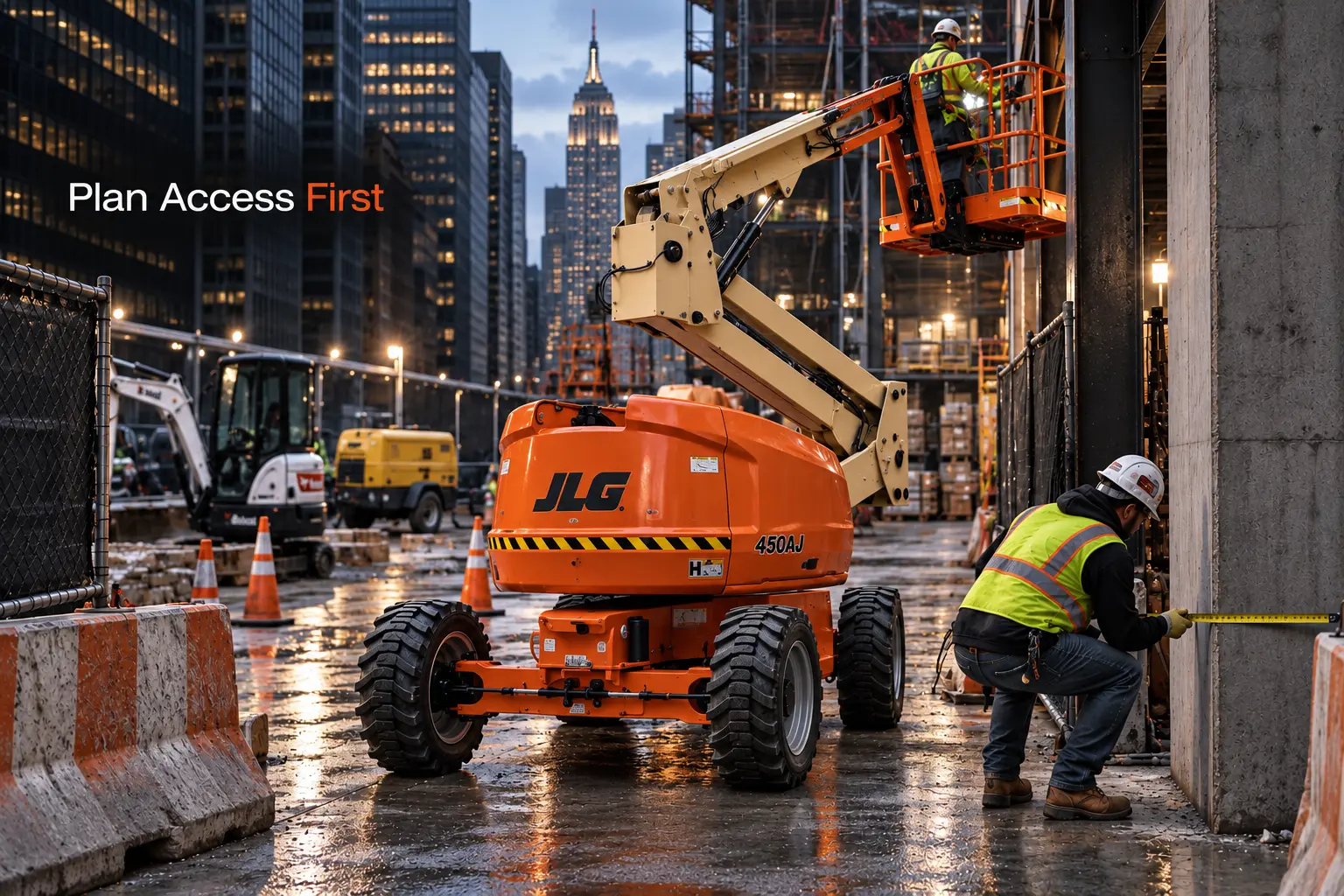
Getting a boom lift onto a jobsite sounds simple until the truck shows up and the gate is four inches too narrow. In New York City, that mistake costs a day, sometimes more. Between narrow entrances, protected sidewalks and uneven lot conditions, boom lift jobsite access has to be planned before the machine is booked, not after it arrives.
At J.E.H Equipment Rentals, we walk contractors through this step before every aerial lift rental. Here’s what actually matters when you’re figuring out whether a boom lift will fit, move and work safely on your site.
What Jobsite Access Actually Means for a Boom Lift
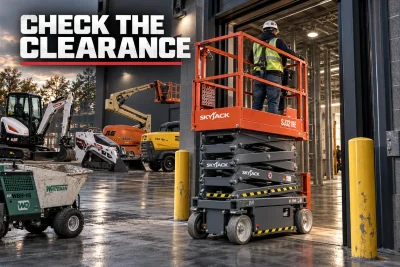
Jobsite access isn’t just “can the truck get in.” It covers four separate questions: Can the lift physically enter the site? Can it be unloaded safely? Can it maneuver once it’s inside? And can it reach the work area without hitting something overhead or beside it?
Contractors who only check the entrance width often get surprised by the second and third questions. A gate might clear the machine’s transport width, but the turning radius inside a courtyard or loading dock is a separate calculation entirely.
How Much Space Does a Boom Lift Need?
Space requirements come down to three numbers: stowed width, stowed height and turning radius. On a standard articulating boom lift, stowed width typically runs close to 8 feet, with a turning radius in the range of 15 to 16 feet.
Before booking, measure:
- Gate and doorway width, including any mirrors, hoses or side-mounted equipment that add inches to the stated spec
- Overhead clearance, especially under scaffolding, awnings or low utility lines common on older Brooklyn and Manhattan blocks
- Turning space once inside, not just at the point of entry
Pro tip: if you’re working from blueprints instead of a site walk, add a buffer. Drawings rarely account for parked dumpsters, staged materials or temporary fencing that shrinks usable width on delivery day.
Ground Conditions That Make or Break Access
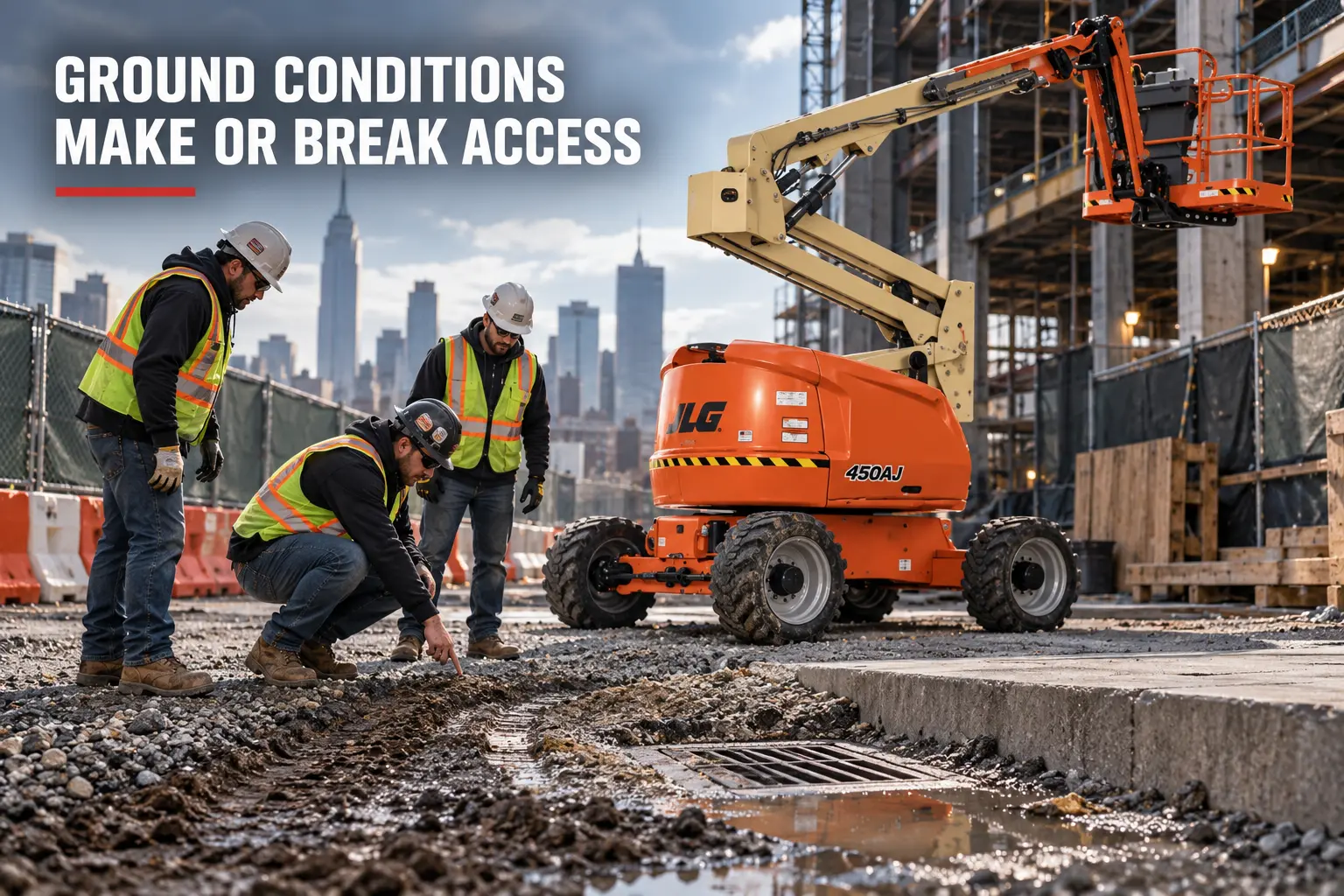
A boom lift that fits through the gate can still be the wrong call if the ground can’t support it. Soft soil, loose gravel or a freshly poured slab that hasn’t cured all affect stability and ground bearing pressure.
Things to check on-site:
- Is the surface concrete, asphalt, gravel or exposed soil?
- Has there been recent rain or excavation nearby that softened the ground?
- Is there a slope and does it fall within the machine’s rated gradeability?
- Are there utility lines, catch basins or vaults under the surface that can’t bear the load?
On older Long Island properties and dense NYC lots, we’ve seen contractors plan around entrance width and completely overlook ground conditions. That’s usually the costlier mistake, since it can mean a stalled lift or an unsafe setup rather than just a delayed delivery.
Planning Access for Tight NYC and Long Island Sites
Urban and suburban jobsites each bring their own access challenges. In Queens, Brooklyn and Manhattan, the constraint is almost always width: narrow lots, protected sidewalks and building setbacks that leave little room to maneuver. On Long Island sites in Suffolk and Nassau County, the issue is more often ground condition and reach, since properties tend to be larger but softer or unevenly graded.
Either way, the fix is the same: a short access plan before the lift ships. That means confirming entrance dimensions, ground surface, overhead obstructions and the exact reach needed to hit the work area without repositioning constantly.
Our team at J.E.H handles this conversation on nearly every tight access equipment rental we put on a jobsite, because getting it right up front avoids a wasted trip.
Why the JLG 450AJ Works for Restricted Jobsites
The JLG 450AJ rental is one of the machines we recommend most often for restricted urban and suburban sites and there’s a reason for that. It’s an articulating boom, which means the arm bends around obstacles instead of requiring a straight-line approach the way a straight telescopic boom does.
Working figures on the 450AJ:
- Working height around 51 feet
- Horizontal outreach in the range of 25 feet
- Stowed width close to 8 feet
- Diesel, four-wheel drive for uneven or unpaved ground
That combination lets it access rooftops, facades and elevated work areas around scaffolding, parked vehicles and building corners without needing a wide-open lot. For crews doing facade repair, exterior maintenance, HVAC installs or electrical work above street level, it’s built for exactly the kind of restricted access common across Queens, Brooklyn and the rest of the five boroughs.
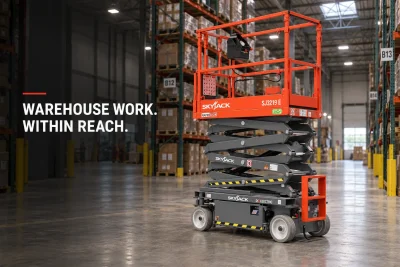
If your site calls for a lower-profile machine instead, the Skyjack SJ3219 scissor lift is worth comparing, particularly for indoor or straight-up vertical work where an articulating arm isn’t necessary.
Delivery and Mobilization: What to Prepare Before the Truck Arrives
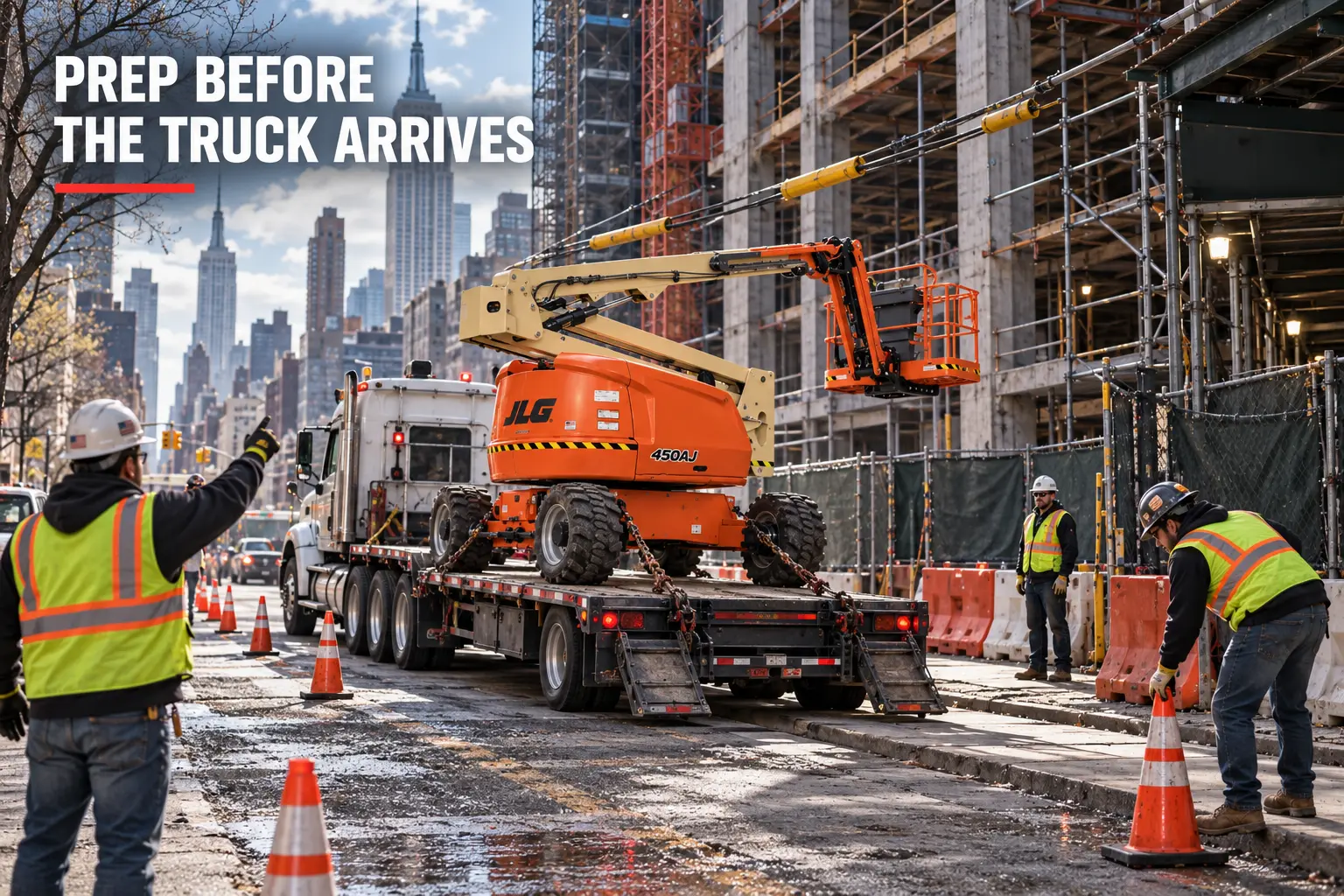
Once access is confirmed, mobilization is the next step. A few things speed this up:
- Clear the drop zone. Remove parked vehicles, dumpsters or staged materials from the unloading area.
- Confirm site contact and hours. NYC job sites often have restricted delivery windows and having someone on-site to direct the driver avoids delays.
- Check permit requirements. If equipment needs to cross a public sidewalk or occupy street space, NYC DOT sidewalk crossing permits may apply and it’s worth confirming before delivery day.
- Flag overhead hazards. Power lines, low awnings or scaffolding near the entry point should be noted for the delivery driver ahead of time.
Our equipment delivery team coordinates directly with site supervisors on timing and access, which cuts down on the back-and-forth that usually causes delays.
Safety and setup requirements for boom lifts are governed under OSHA’s aerial lift standard, 29 CFR 1926.453, which covers fall protection and operating requirements for articulating and extensible boom platforms. It’s a useful reference for crews setting site-specific safety procedures.